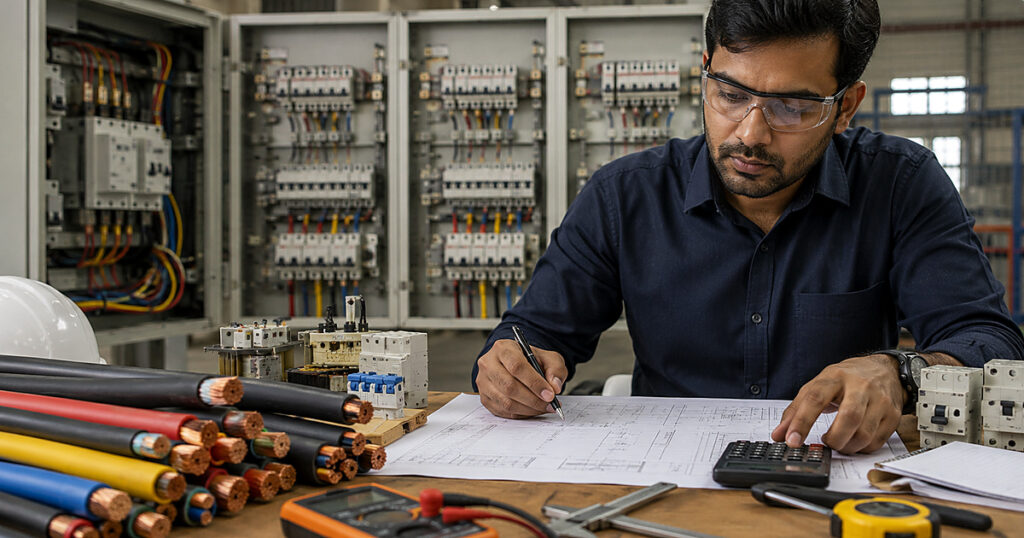

The costliest mistakes around voltage drop calculation cable usually begin with an incomplete enquiry or an assumption copied from another job. A short technical checklist prevents most of them.
Voltage drop rises with current and length and falls when conductor area increases. Check the complete circuit and include motor starting where relevant.
Quick answer
Voltage drop rises with current and length and falls when conductor area increases. Check the complete circuit and include motor starting where relevant.
What the term means
Voltage Drop Calculation Cable should be understood as part of a complete electrical system. The conductor, insulation, route, terminals, protective devices and connected equipment influence one another. A product name by itself cannot describe every performance limit.
The secondary questions around this topic include cable voltage drop formula, long cable run. These phrases describe what users are trying to solve, but a safe answer still needs the actual equipment and site conditions.
Why the decision matters
Confirm current. A change in this factor can justify a different construction even when the nominal conductor size stays the same.
Review one way length. This affects whether the selected voltage drop calculation cable can carry the duty without unnecessary heat or loss.
Do not overlook phase. Writing it in the enquiry makes quotations comparable and gives the installer a clear basis for verification.
A wrong choice can show up as voltage loss, difficult starting, warm terminals, damaged insulation, nuisance tripping, shortened equipment life or an expensive replacement job. The risk is higher when a cable is buried, submerged, concealed or built into a winding because inspection and replacement become difficult.
A reliable selection method
- Step 1: document current. Use a nameplate, drawing, site measurement, applicable standard or manufacturer information as the source.
- Step 2: document one way length. Use a nameplate, drawing, site measurement, applicable standard or manufacturer information as the source.
- Step 3: document phase. Use a nameplate, drawing, site measurement, applicable standard or manufacturer information as the source.
- Step 4: document conductor material. Use a nameplate, drawing, site measurement, applicable standard or manufacturer information as the source.
- Step 5: document area. Use a nameplate, drawing, site measurement, applicable standard or manufacturer information as the source.
- Step 6: document power factor. Use a nameplate, drawing, site measurement, applicable standard or manufacturer information as the source.
After the first selection, check current capacity, voltage drop, normal and starting duty where relevant, environmental exposure, bend radius, terminals and protective devices. Final installation and testing should be completed or reviewed by a competent professional.
How to compare options
| Decision point | What to document | When to verify |
|---|---|---|
| Current | Record the actual requirement and the source of the value. | Verify before purchase, installation or commissioning. |
| One Way Length | Record the actual requirement and the source of the value. | Verify before purchase, installation or commissioning. |
| Phase | Record the actual requirement and the source of the value. | Verify before purchase, installation or commissioning. |
| Conductor Material | Record the actual requirement and the source of the value. | Verify before purchase, installation or commissioning. |
| Area | Record the actual requirement and the source of the value. | Verify before purchase, installation or commissioning. |
Ask every supplier to quote against the same written specification. Compare conductor, finished dimensions, insulation, standard, tests, packing, price basis, delivery and documentation. A lower basic rate is not a saving when the offered construction is different or cannot be traced to a test record.
For repeat purchases, keep an approved datasheet or sample reference and record batch performance. This turns supplier selection from a one time price decision into a controlled quality process.
Common mistakes
A common error is using the wrong route length. A small amount of planning here is cheaper than pulling out cable or rewinding equipment after failure.
A common error is checking only no load voltage. Replace the assumption with a measured value and a written acceptance criterion.
A common error is ignoring joint resistance. Pause the work, check the applicable instruction and correct the root cause before energising.
Another frequent problem is changing one part of the system without checking the rest. A larger breaker, different connector, longer route or new motor can invalidate an earlier cable choice even when the old installation appeared to work.
A practical example
A deep borewell pump may have adequate thermal capacity but still struggle to start because the long cable delivers low voltage at the motor.
The example shows why the final decision should be traceable. Write down the inputs, the selected construction, the reason for selection and the readings taken during commissioning. If performance changes later, the technician can compare new measurements with a known baseline rather than beginning with guesswork.
Checklist
- Current confirmed
- One Way Length confirmed
- Phase confirmed
- Conductor Material confirmed
- Area confirmed
- Power Factor confirmed
- Applicable standard checked
- Supplier and batch details recorded
- Installation and test responsibility assigned
Frequently asked questions
Can voltage drop calculation cable be selected from one chart or rule?
No. A chart can provide an initial range, but the final choice must include the factors listed in this guide and the actual installation conditions.
What information should be sent with an enquiry about voltage drop calculation cable?
Send the application, electrical rating, size or load, route, environment, construction, standard, quantity, packing and required test documents.
When should a qualified electrical professional be involved?
Use a competent professional for final sizing, protection, isolation, testing, fault diagnosis and any work on an energised or safety critical system.